
Vertical Aluminium Lines Starting a New Vertical Aluminium Powder Coating Line? Five Factors That Determine Long-Term Stability
Equipment Alone Does Not Guarantee Stable Coating Quality
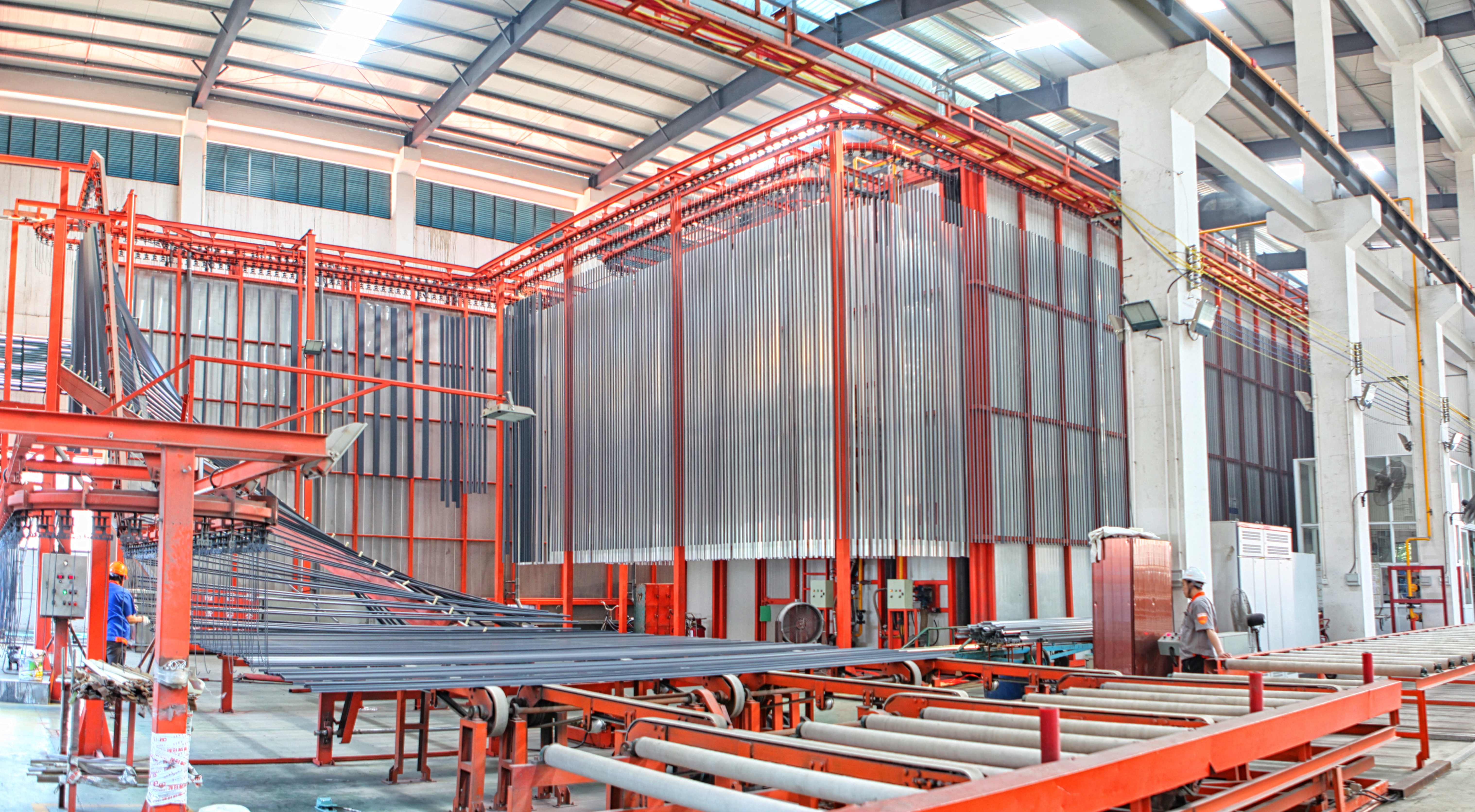
Installing a new vertical aluminium powder coating line is a major investment.
Modern vertical lines can deliver high throughput and automation, but stable output depends on more than equipment.
Pretreatment, powder formulation, spraying parameters and oven conditions must all work together.
During commissioning, manufacturers often encounter problems such as uneven film thickness, poor coverage in recessed areas, color variation, excessive powder use or incomplete curing.
The earlier these issues are controlled, the faster the plant can move from trial production to stable commercial output.
Rivers Powder Coatings has long-term experience in architectural aluminium and supports customers from product selection through line qualification and ongoing production.
1. Choose the Performance Grade Before the Color
Many new plants begin with common colors such as RAL 9003, 9010, 9016 or 9005.
But the first technical question should be:
Where will the aluminium be used?
A standard residential profile and a coastal curtain-wall project do not need the same coating system.
Rivers' architectural aluminium portfolio covers QUALICOAT Class 1, Class 2 and Class 3, together with AAMA 2603, 2604 and 2605-oriented systems.
This gives aluminium manufacturers flexibility to serve multiple market levels—from mainstream windows and doors to higher-durability façade applications.
For customers building a new line, selecting the correct product level from the beginning reduces future requalification work.

2. Pretreatment and Powder Must Be Evaluated Together
Even a premium powder coating cannot compensate for unstable pretreatment.
Cleaning, etching and conversion treatment directly influence adhesion and corrosion resistance.
During commissioning, pretreatment conditions should therefore be stabilized before major conclusions are drawn about powder performance.
Rivers recommends troubleshooting the complete process rather than immediately changing the coating formulation whenever a problem appears.
This reduces unnecessary adjustments and helps customers identify the real cause faster.
3. Control Film Thickness Across Complex Profiles
Vertical lines process aluminium profiles with many different geometries.
Flat external surfaces may coat easily, while grooves, channels and internal corners receive less powder because of electrostatic effects.
Simply increasing powder output can make the exposed surface too thick without solving coverage in recessed areas.
Gun voltage, current, distance, angle and conveyor speed should therefore be optimized together.
Rivers focuses on achieving uniform effective film thickness, not simply the highest film build.
This helps improve both coating performance and powder utilization.
4. Measure Metal Temperature, Not Only Oven Temperature
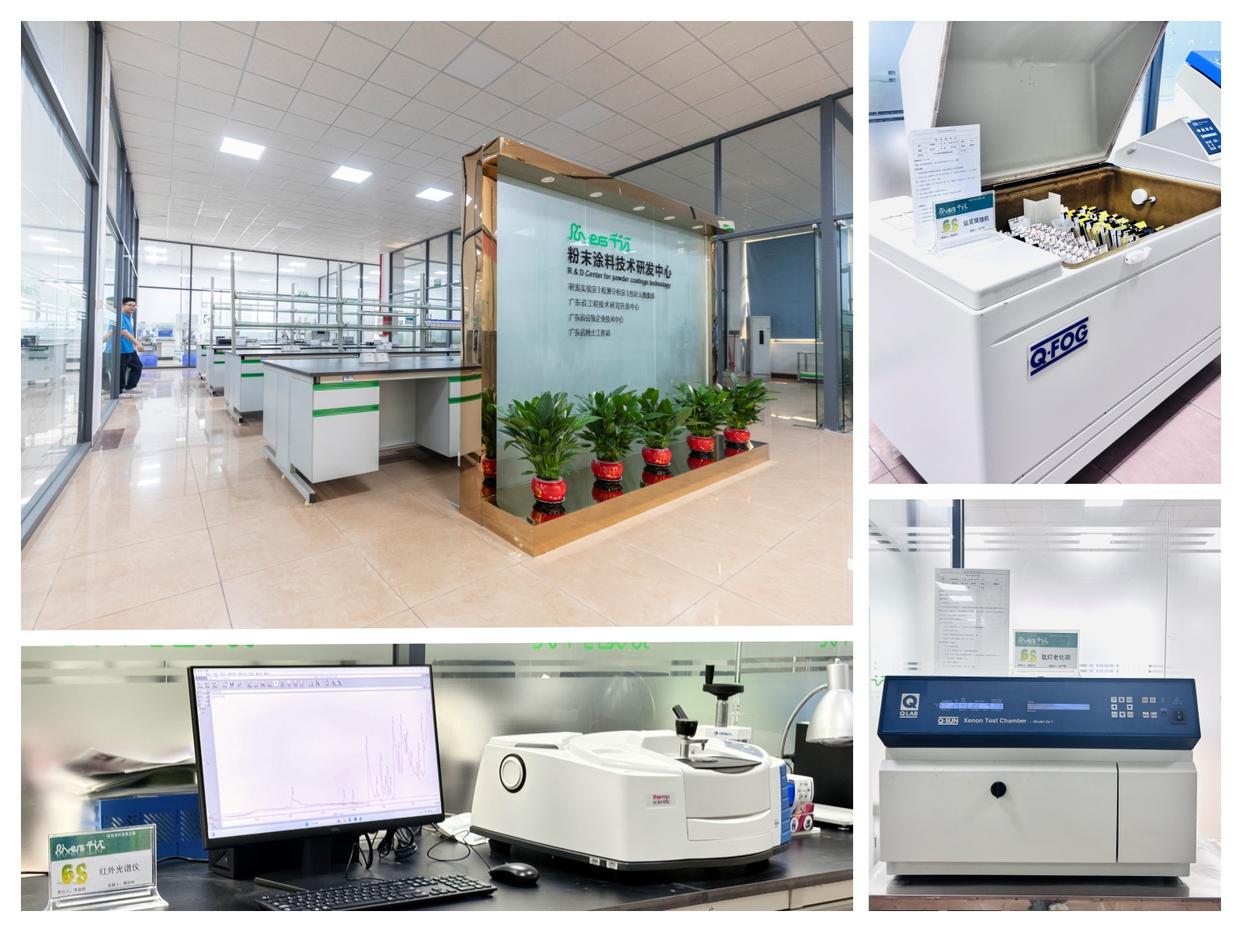
Powder coating cures according to the temperature of the aluminium itself.
The oven display may show the correct number while the actual profile has not yet reached the required curing condition.
Profile thickness, line speed and oven loading all affect this.
Under-curing can reduce adhesion and long-term performance.
Over-curing may affect appearance and productivity.
Rivers can provide product-specific TDS recommendations and technical guidance during line trials so that curing conditions are matched to the actual process.
5. Validate Metallic Colors Separately
After standard white, black and grey are running well, many aluminium plants want to add champagne, bronze, silver and other metallic finishes.
These products require additional control.
Gun settings, profile geometry, film thickness and reclaim ratio can all influence appearance.
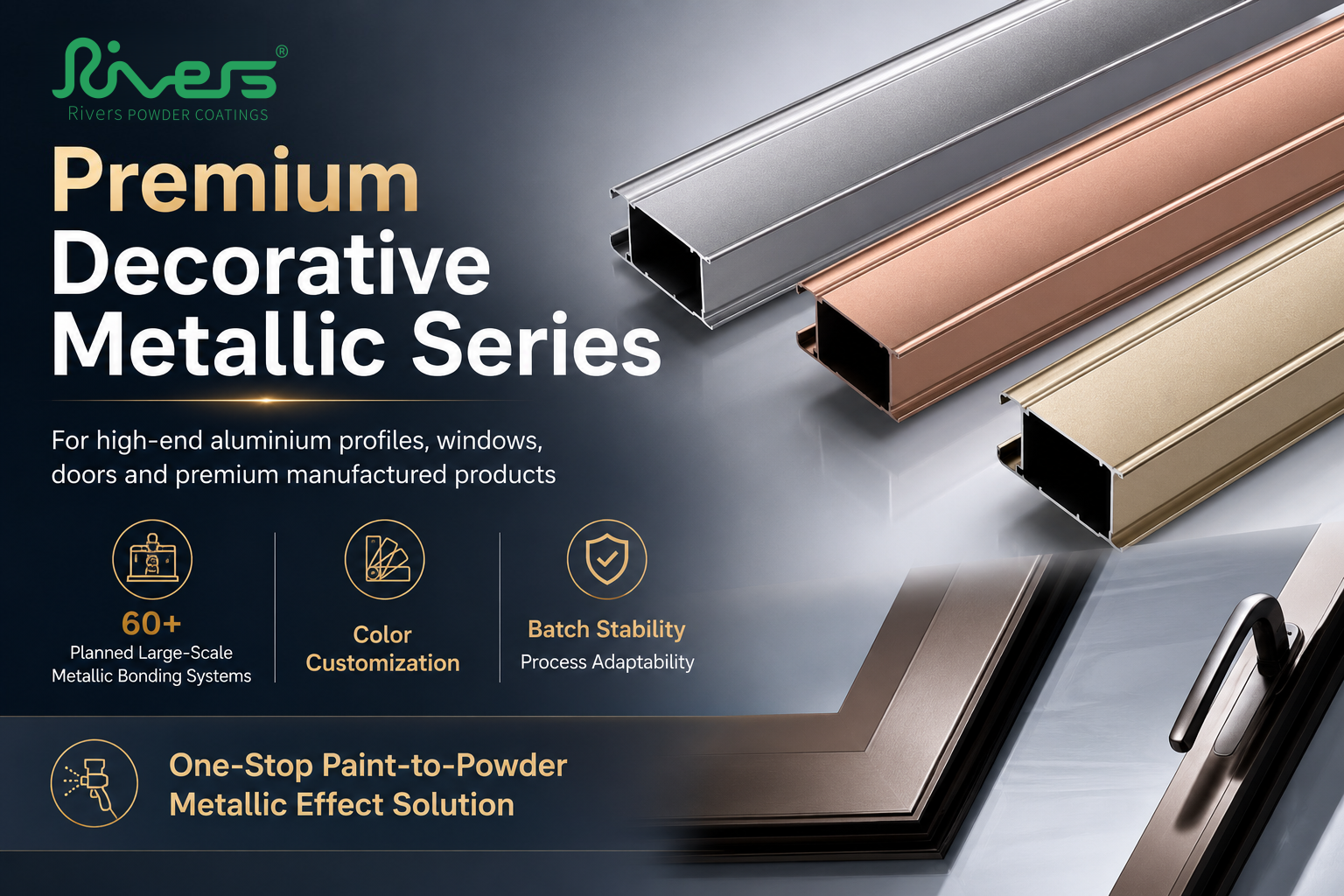
Rivers operates 30+ metallic bonding lines, giving the company significant experience in metallic powder development and production.
But even a well-bonded metallic powder should still be validated on the customer's actual vertical line.
This is especially important for architectural aluminium, where small color differences can become visible when profiles are installed side by side.
Faster Qualification with Rivers
Rivers operates 53 sample-development lines, allowing customers to move quickly through color matching and product qualification.
For standard colors, regular commercial production can typically be arranged in approximately 5–7 days, while metallic products generally require longer processing and verification.
For overseas aluminium manufacturers, Rivers can provide English TDS/SDS, relevant certification documentation and technical recommendations during commissioning.
This reduces the burden on customers who are simultaneously trying to qualify colors, stabilize equipment and prepare for commercial production.
Why Rivers for New Aluminium Lines
Rivers is one of China's Top 6 powder coating suppliers and has extensive experience serving major aluminium profile manufacturers.
The company currently supplies many leading aluminium producers and has accumulated architectural aluminium experience across multiple international markets.
For a new vertical line, this matters because Rivers can support more than the first batch of white powder.
Customers can develop:
standard polyester, Class 1, Class 2, Class 3, metallic, wood-grain and special decorative finishes within one broader product platform.
As the customer's market develops, the coating portfolio can grow with it.
That makes Rivers not only a powder supplier, but a longer-term coating partner for aluminium manufacturers expanding into higher-value products and export markets.
Call to Action
Commissioning a new vertical aluminium coating line or qualifying a new powder supplier? Contact Rivers with your line configuration, target market and required colors. We can support Class 1/2/3 product selection, samples, TDS/SDS, quotations and technical guidance for line trials.

Rivers (Qianjiang) Group
Zhaoqing Qianjiang High-Tech Materials Technology Corporation
Guangdong Huajiang Powder Technology Co., Ltd.
Shandong Qianjiang Powder Technology Co., Ltd.
Guangdong Wesdon Rivers Powder Paints Scientifc Research Co., Ltd.
Zhaoqing Qianjiang Coating Co., Ltd.
Zhuhai Zhengdong Chemicals Co., Ltd.
Zhongshan Yonghan Industrial Additives Co., Ltd.
Guangdong Honglang Technology Co., Ltd.
WhatsApp:+86 150 1171 7323
Mail:global@riversqj.com
Address:
Guangdong Huajiang Powder Technology Co., Ltd.
No. 27 Jianshe Road, Dawang High tech Zone, Zhaoqing, Guangdong Province


