
Powder Coatings for Metal Furniture: Decorative Finishes, Durability and Consistent Production Quality
1. Why Powder Coating Matters in Modern Furniture Manufacturing
Metal furniture has become an important part of residential, commercial and outdoor environments.
From office desks and shelving systems to dining chairs, outdoor tables and premium furniture frames, manufacturers increasingly use powder coatings to combine surface protection with decorative design.
For furniture brands, surface finishing is more than a manufacturing process. It contributes directly to product appearance, perceived quality and customer satisfaction.
A carefully selected coating can create a smooth, contemporary finish, a refined metallic appearance or a distinctive textured surface.
However, furniture coatings must also withstand everyday handling, assembly, transportation and use.
A finish that looks attractive on a sample panel may not perform consistently on welded frames, tubular components or complex furniture structures.
This is why furniture manufacturers need coating systems that balance appearance, mechanical performance and production efficiency.
For powder coating distributors, understanding these requirements creates opportunities to offer application-specific solutions rather than competing only on standard colors and price.
2. Popular Powder Coating Finishes for Metal Furniture
Different furniture categories require different surface appearances.
Fine Texture and Sand Texture
Fine-textured powder coatings are widely used for office furniture, shelving, metal cabinets and contemporary furniture frames.
These finishes create a controlled, relatively low-reflection surface that can complement minimalist designs.
Depending on the formulation, fine textures may also help reduce the visibility of minor substrate imperfections.
Black, white, grey and neutral tones are common starting points, although manufacturers increasingly request customized shades.
For furniture production, texture consistency is essential. Film thickness, spray parameters and curing conditions can influence the final appearance.
Matt and Ultra-Matt Finishes
Matt finishes are popular in contemporary furniture design because they create a clean and understated appearance.
However, lower gloss does not automatically mean better scratch resistance.
Some very low-gloss surfaces may show rubbing marks, polishing effects or handling-related changes more readily than expected.
Manufacturers should therefore evaluate gloss, surface feel, abrasion behavior and cleaning requirements together.
Metallic and Decorative Effects
Metallic powder coatings provide additional design possibilities for furniture manufacturers.
Champagne gold, bronze, graphite and other metallic finishes can create a premium appearance for chair frames, table legs, shelving and decorative components.
More distinctive effects, including color-shifting finishes, can be considered for selected design-oriented products.
The challenge is maintaining a consistent metallic appearance across different component shapes and production batches.
Crocodile Texture and Special Finishes
Crocodile Texture offers a more pronounced decorative surface than conventional fine textures.
It can be considered for furniture components where a distinctive tactile and visual effect is desired.
However, highly textured finishes require careful evaluation of cleaning, assembly, contact surfaces and customer expectations.
The most attractive finish is not necessarily the most suitable for every application.

3. Scratch Resistance and Everyday Durability
Furniture coatings are exposed to repeated contact during transportation, installation and daily use.
Chairs may be moved across floors, tables may be cleaned frequently, and metal cabinets may experience repeated handling.
For this reason, furniture manufacturers often request coatings with improved resistance to scratching, abrasion and mechanical damage.
However, scratch resistance is not a single universal property.
A coating may perform well in a pencil hardness test but behave differently under repeated rubbing or contact with a sharp object.
Relevant evaluation methods may include abrasion resistance, impact resistance, adhesion and application-specific scratch testing.
The substrate and coating thickness also influence performance.
For furniture manufacturers, the most useful testing approach is to reproduce the type of contact or wear that the finished product will experience.
A coating intended for a decorative indoor chair frame may require a different performance balance from one used on an outdoor metal table.
4. Indoor and Outdoor Furniture Need Different Coating Systems
One of the most important distinctions in furniture coating selection is the intended operating environment.
Indoor furniture generally places greater emphasis on decorative appearance, handling resistance and cleaning performance.
Outdoor furniture must also withstand sunlight, moisture, temperature changes and potentially corrosive environments.
For outdoor steel furniture, corrosion protection depends on the complete coating system, including substrate preparation and pretreatment.
A suitable exterior-grade polyester powder coating may provide weather-resistant color and appearance, but its performance must be confirmed for the intended environment.
For more demanding steel applications, additional corrosion-protection measures or a suitable primer system may be necessary.
Manufacturers should avoid assuming that a decorative powder coating designed for indoor furniture will automatically provide adequate outdoor durability.

5. Why Production Consistency Matters More Than a Perfect Sample
Furniture manufacturing often involves multiple components produced in different batches.
A dining chair may include welded tubular frames, brackets and decorative metal parts.
A shelving system may combine flat panels, profiles and smaller accessories.
Even when the same powder coating is used, differences in application conditions can influence the final appearance.
For metallic and textured finishes, these variations may be particularly noticeable.
Manufacturers should establish approved physical reference samples and define acceptable appearance tolerances.
Production trials should consider component geometry, film thickness, curing conditions and the use of reclaimed powder where applicable.
A reliable coating supplier should help customers move beyond sample approval toward repeatable production quality.
6. Rivers: Decorative Powder Coating Experience for Metal Furniture
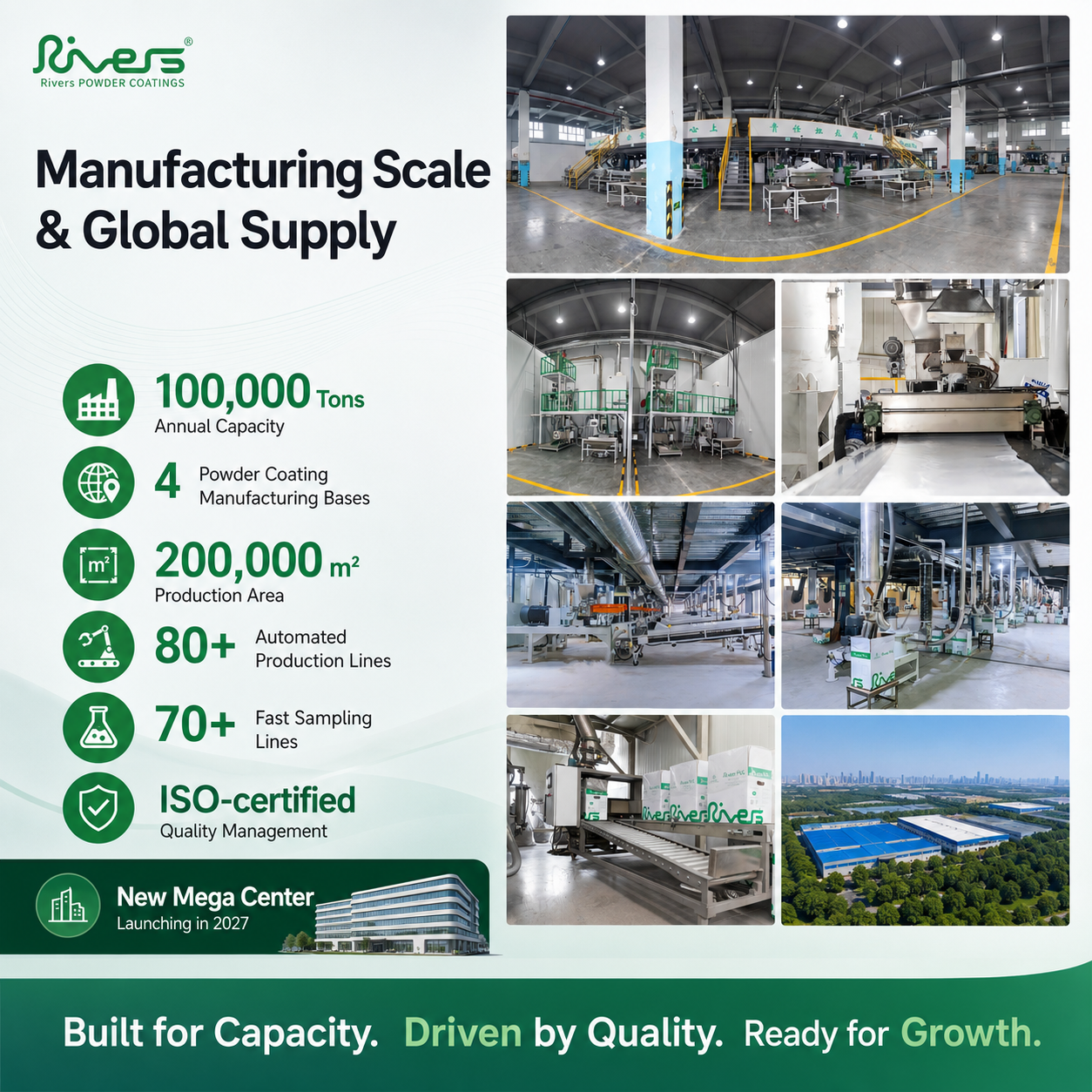
Established in 1996, Rivers Powder Coatings has developed thermosetting powder coating solutions for furniture, architectural metal, appliances and other industrial applications.
Metal furniture is one of the application areas in which Rivers has accumulated product-development and customer-support experience.
For furniture manufacturers, Rivers offers decorative powder coating options covering solid colors, matt finishes, fine textures and selected metallic effects.
These products can be evaluated according to the furniture design, substrate, intended environment and production requirements.
Rather than treating every furniture project as a standard color request, Rivers focuses on matching the coating appearance with the customer's actual manufacturing process.
This approach is particularly relevant to manufacturers developing new furniture collections or expanding into higher-value decorative products.
From Design Reference to Physical Sample
Furniture customers often begin with a design reference rather than a complete coating specification.
They may provide a metal component, a color reference, a texture sample or a photograph showing the desired appearance.
The coating supplier must then translate that reference into a practical powder coating solution.
Rivers operates 100 dedicated sample-development lines, supporting customized color, gloss and surface-finish development.
These resources allow customers to compare alternative appearances before selecting a coating for production trials.
For furniture manufacturers, this can help streamline communication between design, purchasing and production teams.
7. More Than 30 Metallic Bonding Lines for Decorative Finishes
Metallic powder coatings require particular attention to pigment distribution, appearance consistency and application behavior.
Rivers operates more than 30 metallic bonding lines, providing dedicated manufacturing resources for bonded metallic powder coatings.
This capability supports the development and production of metallic finishes for suitable furniture and industrial applications.
For customers developing champagne, bronze, graphite or other metallic furniture finishes, bonded metallic powder technology can offer advantages over simple dry-blended systems in pigment attachment and handling consistency.
However, the final appearance still depends on formulation, spray equipment, component geometry and production parameters.
Actual-line validation remains essential.
For furniture brands, dedicated metallic coating capabilities provide more opportunities to develop differentiated product collections.
For distributors, they create a broader product offering beyond conventional solid-color powder coatings.
8. What Rivers Brings to Furniture Manufacturers and Distributors
For international furniture manufacturers, selecting a powder coating supplier involves several practical considerations.
Customized decorative development: Rivers' 100 dedicated sample-development lines support the evaluation of colors, textures, gloss levels and special finishes.
Metallic coating capability: More than 30 metallic bonding lines provide manufacturing resources for selected decorative metallic products.
Multi-industry application experience: Rivers' experience in furniture and other industrial metal applications supports discussions about appearance, substrate compatibility and production requirements.
International technical communication: English Technical Data Sheets, Safety Data Sheets and available product-specific test information can support overseas customer evaluation.
Together, these capabilities help customers establish a more structured development process.
A furniture manufacturer can begin with a design concept, evaluate physical samples, conduct production trials and progressively establish an approved coating specification.
For distributors, this creates opportunities to serve customers seeking customized finishes rather than only standard RAL colors.
The commercial value lies in helping customers develop distinctive products while reducing uncertainty during coating selection and production approval.
9. From Decorative Design to Repeatable Commercial Supply
Successful furniture coating development requires both creativity and manufacturing discipline.
An attractive metallic finish or carefully designed texture may help differentiate a furniture collection, but long-term customer satisfaction depends on consistent production quality.
Rivers combines decorative powder coating development, dedicated sampling resources and metallic bonding capabilities to support this process.
For overseas customers, the objective is to establish a practical route from initial appearance development to technical evaluation and repeat commercial supply.
The right furniture coating should look good on the first sample—and remain consistent when the next production order arrives.
Call to Action
Looking for customized powder coatings for metal furniture?
Contact Rivers with your substrate, reference sample, target finish, application environment and production requirements.
Our team can support decorative finish development, customized sampling, metallic coating selection and technical evaluation.
Rivers Powder Coatings — Decorative Finishes Developed for Real Manufacturing.

Rivers (Qianjiang) Group
Zhaoqing Qianjiang High-Tech Materials Technology Corporation
Guangdong Huajiang Powder Technology Co., Ltd.
Shandong Qianjiang Powder Technology Co., Ltd.
Guangdong Wesdon Rivers Powder Paints Scientifc Research Co., Ltd.
Zhaoqing Qianjiang Coating Co., Ltd.
Zhuhai Zhengdong Chemicals Co., Ltd.
Zhongshan Yonghan Industrial Additives Co., Ltd.
Guangdong Honglang Technology Co., Ltd.
WhatsApp:+86 150 1171 7323
Mail:global@riversqj.com
Address:
Guangdong Huajiang Powder Technology Co., Ltd.
No. 27 Jianshe Road, Dawang High tech Zone, Zhaoqing, Guangdong Province


