
How to Choose Powder Coating for Architectural Aluminium: From QUALICOAT Class 1 to Class 3 and AAMA 2603 to 2605
Architectural Powder Coating Should Start with the Building, Not the Color
When an aluminium extruder receives a new project, the first coating discussion often begins with color:
RAL 9016 or RAL 9003? Smooth or fine texture? Matt or gloss? Champagne or metallic grey?
These questions matter, but they should not come first.
For exterior aluminium windows, doors, curtain walls, façades, pergolas and other architectural components, the more important starting point is:
Where will the building be located, and how long is the coating expected to retain its appearance?
An inland residential window and a landmark façade exposed to intense sunlight do not necessarily need the same powder coating.
Selecting the correct architectural powder therefore requires a balance between weatherability, project specification, appearance and cost.
Rivers Powder Coatings has developed a tiered architectural aluminium portfolio covering QUALICOAT Class 1, Class 2 and Class 3, together with systems developed around AAMA 2603, 2604 and 2605 performance levels. Rather than treating “outdoor polyester” as one universal product, this structure allows coating performance to be matched more closely to the project.
Class 1, Class 2 and Class 3: What Changes?
The main difference is long-term exterior durability.
A standard architectural polyester may be entirely appropriate for many mainstream building applications. More demanding façades, however, can require stronger resistance to gloss loss, color change and weathering.
Rivers organizes its architectural products into different performance tiers, including systems such as:
JG Series for mainstream exterior architectural applications;
JZ / JZ-Pro Series for enhanced durability;
NJ Series for higher-performance exterior applications;
CJ Series aligned with super-durable architectural requirements;
FC Series for the most demanding long-term weatherability applications.
Depending on the specific product and qualification, Rivers can support architectural projects across QUALICOAT Class 1/2/3 and AAMA 2603/2604/2605-related performance requirements.
This gives aluminium extruders and distributors a more useful selection method than simply choosing between “normal” and “super durable.”
The important principle is not to buy the highest grade automatically.
It is to choose the appropriate durability level for the building's environment, expected service performance and budget.

Climate Should Influence Product Selection
Architectural aluminium can experience very different conditions depending on where it is installed.
Strong UV exposure can accelerate color and gloss change. Coastal environments introduce salt and humidity. Hot climates can combine intense solar radiation with high surface temperatures. Industrial locations may add atmospheric pollutants.
This is why two buildings using exactly the same RAL color may reasonably require different coating systems.
For example, an aluminium profile manufacturer supplying a conventional residential development may prioritize a balanced standard architectural polyester.
A premium commercial façade in a demanding climate may justify a higher weatherability system.
A landmark project with exceptionally long appearance-retention expectations may move further toward the highest architectural durability level.
For overseas buyers, defining the environment before requesting a quotation makes the comparison much more meaningful.
Instead of asking several suppliers to quote “RAL 7016 powder,” ask them to quote RAL 7016 at the required architectural durability level.
That one change can make supplier quotations far more comparable.
Color Can Affect Durability Decisions Too
Weatherability is not determined by resin chemistry alone.
Color and effect pigments also matter.
Some colors are naturally easier to stabilize for long-term exterior exposure than others. Highly saturated colors and certain special-effect finishes may require additional formulation attention.
Metallic architectural colors introduce another challenge.
Champagne, bronze, silver and metallic grey are widely used on modern aluminium façades and window systems, but their appearance can be influenced by spray parameters, reclaim ratio and equipment settings.
Rivers operates 30+ large-scale metallic bonding lines, providing dedicated manufacturing capability for metallic powder coatings.
For architectural customers, the value is not simply the number of bonding machines. Dedicated bonding capability supports more consistent industrial production of demanding metallic effects and helps reduce the gap between an approved sample and later commercial batches.
For major façade projects, retaining an approved master panel is also advisable so future production can be compared against a controlled visual reference.

Powder Performance Cannot Compensate for Poor Pretreatment
Even a high-weatherability powder needs a properly prepared aluminium substrate.
Cleaning and pretreatment influence adhesion and long-term coating performance. Contamination, insufficient pretreatment or poor process control can undermine an otherwise capable powder.
Curing is equally important.
A powder specified for a certain curing window must reach the required metal temperature, not simply be placed in an oven whose air display shows the nominal temperature.
Profile wall thickness, loading density and line speed can all affect the actual cure.
This is particularly relevant when an aluminium extruder changes powder suppliers but wants to maintain existing production speed.
Supplier qualification should therefore include an actual line trial rather than relying only on laboratory panels.
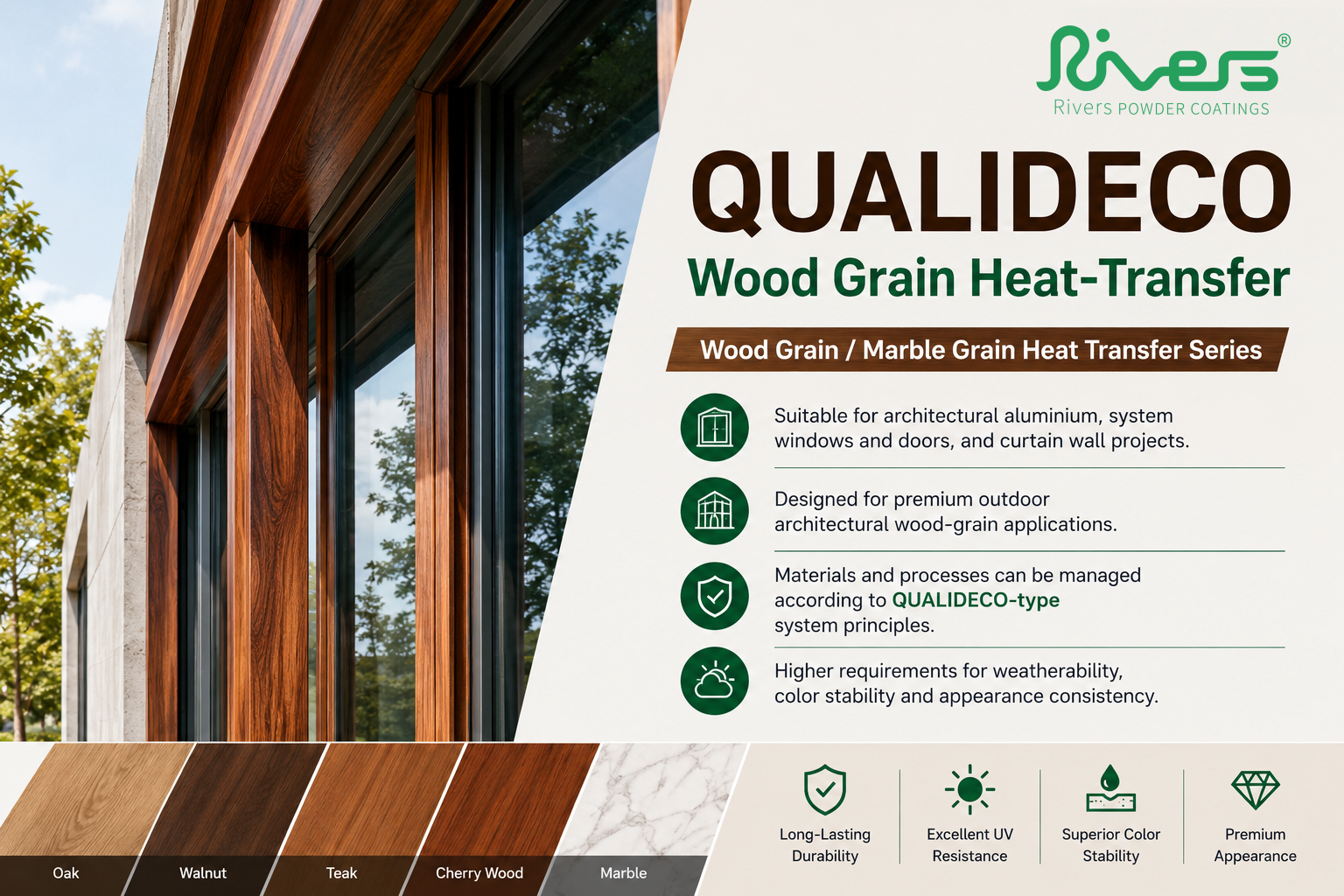
Wood Grain Requires a System Approach
Wood-effect aluminium has become increasingly popular for windows, doors, fencing, pergolas and decorative architectural elements.
Here again, the visible pattern is only part of the performance.
The final result depends on the base powder, curing conditions and sublimation-transfer process.
Rivers has QUALIDECO-related capability for decorative aluminium applications and develops powder systems intended for wood-grain transfer.
For these products, storage and transport conditions can also be important. Rivers recommends controlled storage conditions for relevant wood-grain powder systems, particularly in hot climates.
For buyers, the lesson is straightforward:
A visually attractive wood grain should still be evaluated as a technical coating system, especially when the finished aluminium will be installed outdoors.
Choosing the Right Level Instead of the Highest Level
A useful architectural selection process can begin with five questions:
1. Where will the aluminium be installed?
Indoor, inland exterior, coastal, high-UV or another demanding environment?
2. What does the project specification require?
QUALICOAT class, AAMA performance level or another defined standard?
3. How long is appearance retention expected?
This influences whether a standard, super-durable or higher-performance system is appropriate.
4. What color and surface effect are required?
Smooth, matt, fine texture, metallic or wood grain?
5. What are the customer's actual coating-line conditions?
Pretreatment, oven profile, line speed, reclaim practice and equipment all matter.
This approach avoids unnecessary over-specification while reducing the risk of selecting a coating that is inadequate for the project.
Why Architectural Aluminium Is a Rivers Core Application
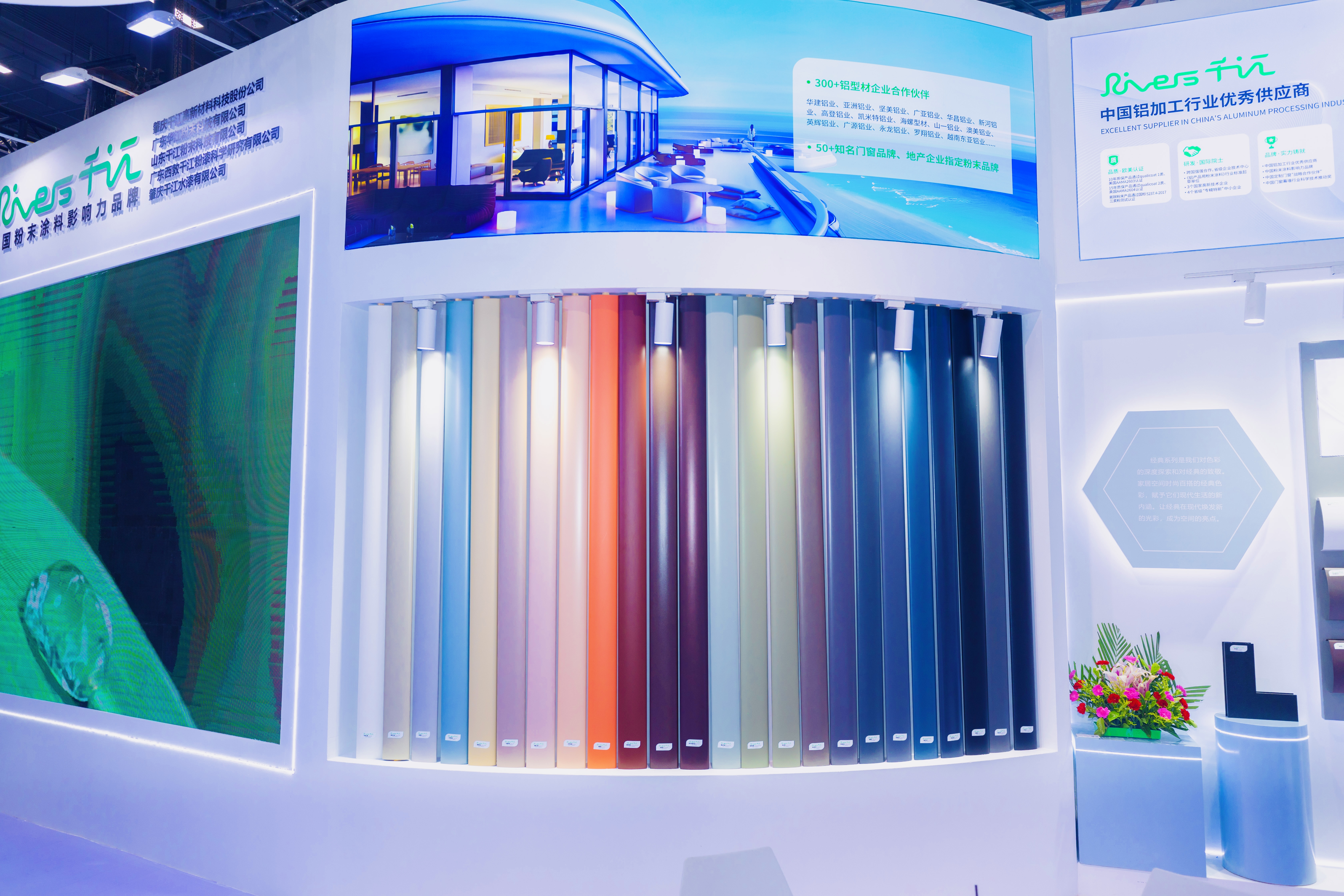
Architectural aluminium is one of Rivers' established application areas.
Rivers has experience supplying many leading aluminium profile manufacturers in China and has also developed aluminium projects in markets across Central Asia, Africa, the Middle East and other overseas regions.
The practical value for international customers is the combination of multiple architectural durability levels, QUALICOAT Class 1/2/3 capability, AAMA 2603/2604/2605-related systems and strong metallic-finish manufacturing capacity.
That allows discussions to begin with the building requirement rather than forcing every customer into one generic exterior polyester.
Rivers can also provide English TDS/SDS, available test documentation, color development and technical support for overseas qualification projects.
The result is a clearer route from architectural specification to sample approval and commercial production.
From Project Specification to Stable Supply
A professional architectural powder qualification process can follow this route:
Project Environment → Required Standard → Durability Level → Color & Finish → Laboratory Sample → Aluminium Profile Trial → Performance Review → Master Sample Approval → Commercial Production
For distributors, this structure is particularly useful.
Instead of competing only on powder price, the distributor can help customers choose an appropriate coating level for each project.
That changes the conversation from:
“How much is one kilogram of RAL 9005?”
to:
“Which RAL 9005 system is appropriate for this building?”
That is a much stronger foundation for long-term architectural coating business.
Call to Action
Working on an architectural aluminium project? Send Rivers the target market, project environment, required QUALICOAT/AAMA level, RAL color or physical sample, gloss and surface finish. We can support product selection, color matching, trial samples, English TDS/SDS, available test documentation and technical evaluation before commercial supply.

Rivers (Qianjiang) Group
Zhaoqing Qianjiang High-Tech Materials Technology Corporation
Guangdong Huajiang Powder Technology Co., Ltd.
Shandong Qianjiang Powder Technology Co., Ltd.
Guangdong Wesdon Rivers Powder Paints Scientifc Research Co., Ltd.
Zhaoqing Qianjiang Coating Co., Ltd.
Zhuhai Zhengdong Chemicals Co., Ltd.
Zhongshan Yonghan Industrial Additives Co., Ltd.
Guangdong Honglang Technology Co., Ltd.
WhatsApp:+86 150 1171 7323
Mail:global@riversqj.com
Address:
Guangdong Huajiang Powder Technology Co., Ltd.
No. 27 Jianshe Road, Dawang High tech Zone, Zhaoqing, Guangdong Province


